23 days later
By Ted Oberg, David Aguillard and Sarah Rafique
July 11, 2022
C
hildren’s backpacks were still piled up outside with homework scattered across the ground and papers blowing in the wind.
Bullets ricocheted off hurricane-grade glass just days earlier, and the bloodstains were still visible when Florida lawmakers visited Marjory Stoneman Douglas High School in Parkland, Florida.
It looked like a “battlefield.”
Fourteen students and three teachers died Feb. 14, 2018, during a mass shooting at the school, located 25 miles north of Fort Lauderdale, Florida.
After visiting the campus and seeing the graphic crime scene, lawmakers acted fast, getting laws passed in just 23 days.
Then-Republican Gov. Rick Scott and the Republican-led House and Senate agreed to sign the Marjory Stoneman Douglas High School Public Safety Act into law on March 9, 2018, allowing - among other reforms - a judge to temporarily restrict gun access to Floridians who are at risk of harming themselves or others.
Those 23 days of pain were followed by compromise and what lawmakers on both sides of the aisle call “common sense gun laws” that raised the legal age to purchase a gun from 18 to 21 and instituted a three-day waiting period from the time a firearm is purchased and when the buyer can leave the store with it.
But 23 days after a mass shooting in Uvalde left 19 students and two teachers dead, Texas managed to only appoint committees tasked with determining what happened at Robb Elementary School on May 24, 2022. Some of those meetings were held behind closed doors.
On June 1, Texas Gov. Greg Abbott also called for the creation of special legislative committees to review what steps previous legislatures have enacted to make recommendations so “meaningful action can be made on, among other things, the following topics to prevent future school shootings: school safety, mental health, social media, police training and firearm safety.”
As of now, the only additional funding stemming from the massacre has been allocated for mental health and school safety training.
Chapter One:
Parkland
Chapter Three:
Bipartisan efforts
Chapter Two:
Deadly scene
Chapter Four:
Red flag laws
Chapter Five:
Texas' move
Chapter One:
23 days later
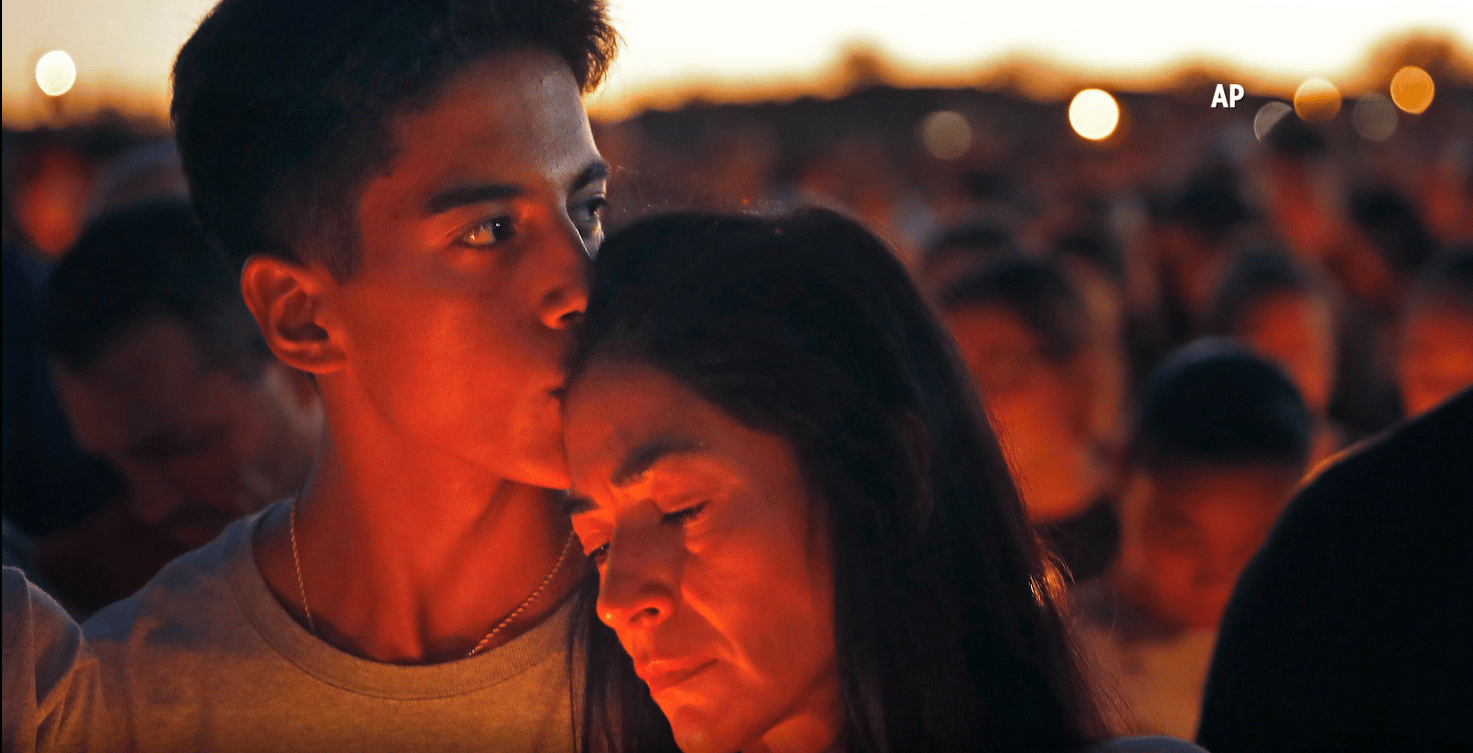
When 14 students and three teachers died during a high school shooting in Florida on Feb. 14, 2018, lawmakers acted swiftly.
Just 23 days later, Florida enacted sweeping bipartisan gun control laws. The state raised the age to buy all guns from 18 to 21, instituted a three-day waiting period, created a Red Flag Law which has been used more than 8,000 times and spent hundreds of millions on school safety and mental health.
Three months after the Parkland shooting, eight students and two teachers were killed at a high school in Santa Fe, Texas, allegedly by a teen.
Texas lawmakers took a different approach, focusing on school safety and mental health. Now, four years later, tragedy struck another Texas school when a teenage gunman killed 19 students and two teachers at Uvalde's Robb Elementary School.
Whenever Florida passed its gun reform laws, the State House and State Senate were both led by Republicans and the Governor was Republican too. Our 13 Investigates team wanted to know how one conservative state was able to pass bipartisan gun laws – and if it’s possible here in Texas.
We visited Parkland and talked with families of the victims. We spoke with Republican and Democratic leadership, who say visiting the active crime scene and seeing the blood and bullets firsthand spurred them to take action fast. We attended red flag hearings where residents temporarily had access to guns taken away and talked with a Republican sheriff who is a strong Second Amendment supporter but says the red flag process is misunderstood.
Watch our documentary “23 Days” to hear their stories and see how, for one state, change was possible.
In Parkland, which locals considered one of the safest cities in Florida, Schwartz never thought her nephew would die before getting the chance to graduate, go to college or fall in love and have a family of his own.
She didn’t know an alleged shooter walked through the hallways of Douglas High School, wearing a dark baseball cap and backpack and carrying an AR-15-style gun or that people were crying and frantically calling 911 to tell dispatchers there was an active shooter, people injured and “a lot of blood.”
She didn’t know her nephew's classmates were running through the courtyard with their hands up as police directed them toward safety while her nephew lay dying in his English class.
“It’s sickening when I think about it now, but that's how much in denial I was that this could happen to my family,” Schwartz said. “I hope if there's anything that anyone can learn from my story, it's that none of us are immune from this gun violence problem and epidemic in our country.”
CHAPTER TWO:
'None of us are immune' to a deadly scene
Chapter One:
W
hen Gail Schwartz’s mother-in-law texted her that there was a shooting at her nephew’s school, she glanced at her phone and then put it down. She didn’t think twice.
Aunt turned activist
CHAPTER THREE:
Swiftness of bipartisan efforts 'unheard of'
A
fter visiting the crime scene, Galvano sat down in his kitchen and started outlining the skeleton of what became of Marjory Stoneman Douglas School Safety Act, which was signed into law on March 9, 2018, just 23 days after the shooting.
CHAPTER FOUR:
Culture change spurs passage of red flag laws
P
inellas County Sheriff Bob Gualtieri said the Parkland shooting changed the culture of Florida.
CHAPTER FIVE:
Texas' move: Calls for politicians to ‘put blinders on,’ make real change
W
hen he first heard about the Parkland shooting, Moskowitz told his wife to drive to their four-year-old son’s pre-school, which was nearby, and get him. By the time she got there, it was already on lockdown.
13 Investigates how Texas and Florida responded differently after school shootings
If Texas had enacted the same law Florida did four years ago, raising the age of purchase to 21, the Uvalde gunman would not have been allowed to legally purchase his weapon.
Similar committees were formed four years ago after a school shooting in Santa Fe, Texas, which left eight students and two teachers dead. The Santa Fe shooting was mere months after the Parkland and four years before Uvalde.
The suspects in all three shootings were teenage boys. The Parkland and Uvalde gunmen purchased their weapons legally.
However, if Texas had enacted the same law Florida did four years ago, raising the age of purchase to 21, the Uvalde gunman would not have been allowed to legally purchase his weapon.
13 Investigates traveled to Florida to speak with Democratic and Republican lawmakers to learn more about their bipartisan efforts to pass the Marjory Stoneman Douglas Act.
Our team spent a morning in one of the state’s most conservative counties, attending red flag hearings where Floridians had their right to own and possess guns and ammunition taken away for a year after a judge deemed they were a threat to society.
We also spoke with a Republican Florida sheriff in a county that has utilized red flag laws more than a thousand times since 2018.
Pinellas County Sheriff Bob Gualtieri admits his views on how states should approach school safety changed after Parkland. Now, after seeing how Florida’s gun laws have made his community safer, his advice to Texans is to “step up and change the culture.”
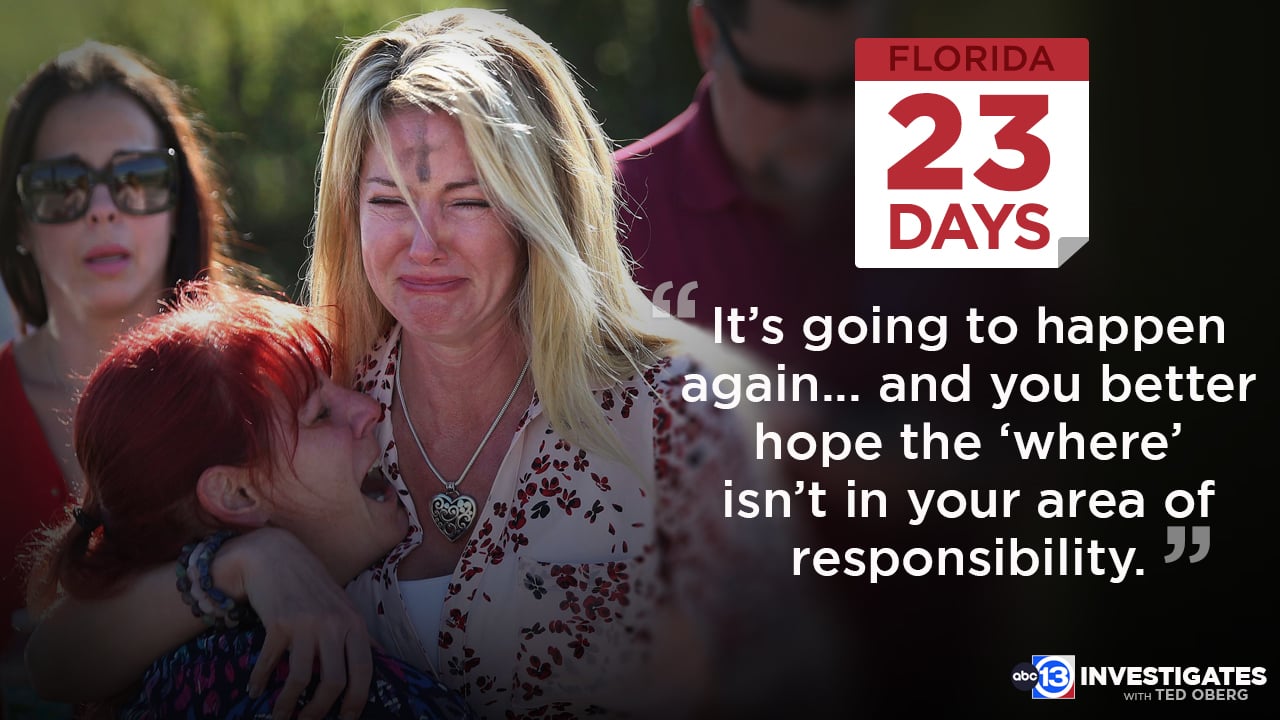
“You need to realize that it's going to happen again,” Gualtieri said. “Question is when, and you better hope the ‘where’ answer to that question isn't in your area of responsibility.”
In the days after the mass shooting, then-Florida State Rep. Jared Moskowitz, who graduated from Douglas High, hoped it would be a wake-up call for lawmakers who had been hesitant to support restrictions on firearm access.
Since red flag laws weren’t passed after a shooter killed 49 people two years earlier at an Orlando nightclub in Orlando, Moskowitz didn’t think lawmakers would act this time either, let alone as quickly as they did.
“I actually was the leader in the house trying to call a special session to get them to do something after Pulse … one of the largest mass shootings in American history. I thought, for sure, well we're going to do something and they didn't even want to go in a special session to talk about it,” Moskowitz said. “So my initial reaction (after Parkland) was they're going to do nothing.”
Moskowitz said he visited the school the evening of the shooting and then went to a nearby hotel where parents were on the ground praying as they waited to hear if their children made it out alive.
He said he stayed there until around 3:30 a.m., as officials pulled families out one-by-one and told them details about how and where their children died.
“I didn't hear crying. I heard screaming,” he said. “It haunts me still.”
Hometown champion: Then-Florida State Rep. Jared Moskowitz, a Democrat, talks with 13 Investigates' Ted Oberg about visiting the school the night of the Parkland shooting and his desire to work with lawmakers across the aisle to implement real change.
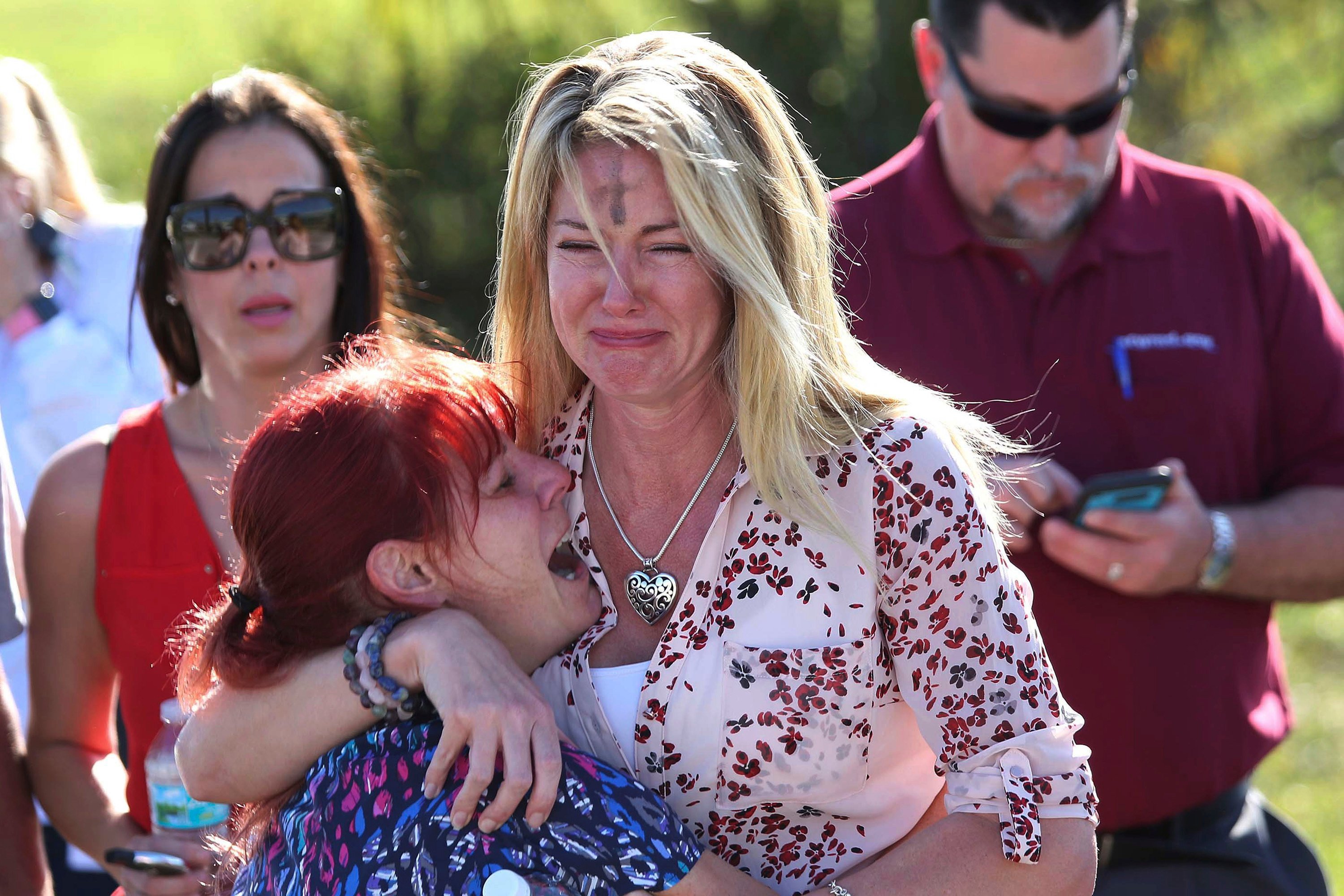
Parents comfort one another at the scene of the Parkland shooting, which happened on Ash Wednesday, Feb. 14, 2018. (AP photo)
While families waited to hear if their children were alive, the Associated Press captured a photo of a woman with a black cross smudged across her forehead while she consoled another weeping mother.
Then-Republican Florida State Senator Bill Galvano went to Ash Wednesday prayer that night and said scenes from the shooting kept playing out in his mind.
He prayed, but said he knew it would require lawmakers to have the “guts” to “stop this evil” instead of just worrying “about the politics of it.”
“There's no reason why I should be more safe in the State Capitol than our children are in our schools,” Galvano said. “At that point, thoughts and prayers were not enough. Obviously you pray and you think about the (victims) and sympathize but we had to take action, comprehensive action.”
In Florida, which Moskowitz referred to as a “Gunshine state,” politics were controlled by the Republican party, including the Senate, House and then-Gov. Rick Scott.
He knew lawmakers needed to see the devastation firsthand.
“They can't stay in their office in (the capital of) Tallahassee and watch it on TV and every Republican leader who came to the school was crying because it shakes you to your core,” Moskowitz said. “It reminded them, I believe, that they’re parents and that if it can happen in Parkland, which was the safest city in all of Florida, it can happen in their neighborhood.”
When Galvano and other lawmakers visited the school, he said it still looked like an active crime scene. He could help but become emotional.
“When you can actually see where the assailant, I'm not going to say his name, was trying to shoot down on the students … the papers blowing in the wind, the literally, the pooling of blood, those are images that give you an inner perspective,” Galvano said. “It created in me a sense of urgency that this type of thing cannot happen again. You can’t just nibble around the edges, that we had to do something and had to make our approach absolutely comprehensive (to) change the course of school safety in the State of Florida.”
As lawmakers from both sides of the aisle finally gained their composure, the sentiment among everyone was the same, Moskowitz said.
“We were all talking about, we're going to do something,” he said. “We cannot have this happen again.”
That evening, Moskowitz said Republicans and Democrats went to dinner and started scrawling their plans on a napkin, including where they agree, where they disagree and where they might be able to take something from the “don’t agree” column and move it to the “agree” column.
There was yelling and arguing and slamming doors with threats of “the deal is off,” Moskowitz said. But members of both parties were determined to agree on something.
“The one thing that we kept as our North Star is whatever bill we pass, it would've had to prevent what happened in Parkland,” he said. “If we pass a bill and it doesn't prevent what would've happened, then the bill fails the ultimate test.”
Republican lawmaker moved to change: Then-Republican Florida State Sen. Bill Galvano said after visiting the gruesome crime scene, he was moved to start drafting bipartisan legislation to address all aspects of keeping students safe in school, including gun reforms. (AP photo)
“For something that comprehensive, it was unheard of,” said Galvano, who was President-Elect of the Florida Senate and sponsored the measure in 2018. “A bill of that magnitude would usually take a couple years, with weeks upon weeks of committee hearings.”
But, despite lawmakers being well into their annual 60-day session and close to passing budgets when the Parkland shooting happened, Galvano said they knew they had to act quickly instead of just creating workgroups and committees to study what went wrong.
“I thought that was of utmost importance, that we did something; that if that sine die had come at the end of session – the close of session – and we were there and couldn't point to anything that we did that was meaningful, then we would've failed.” he said. "There was no greater issue more important."
Michael Putney, a political reporter at WPLG-TV in Miami, said he never would have imagined any gun-related legislation getting signed into law before Parkland, especially since Florida NRA leader Marion Hammer was one of the most influential gun lobbyists in the state.
But, he believes the lawmakers would have been “morally indicted” if they didn’t act after seeing how many of the children died at the hands of a teenager who “had been missed by all these police agencies.”
“These lawmakers went to the scene while there was still blood and it hadn't been cleaned up and it was ugly and painful,” said Putney, who has been covering Florida politics for 45 years. “They saw that. They talked to some of the survivors and the legislature was in session. To have done nothing would've been a repudiation.”
Both Galvano and Moskowitz said it was easier to pass the legislation since they were in the middle of a regular session.
In Texas, four days after the Uvalde shooting that killed 19 students and two teachers, the Texas Senate Democratic Caucus asked Gov. Abbott on May 28, 2022, to call an emergency special legislative session to address gun violence.
The 13 lawmakers who signed the letter demanded the session include the passage of laws that would, “raise the minimum age to purchase a firearm to 21, require universal background checks for all firearm sales, implement ‘red flag’ laws to allow the temporary removal of firearms from those who are an imminent danger to themselves or others, require a ‘cooling off’ period for the purchase of firearms and regulate civilian ownership of high capacity magazines.”
Last month, on June 1, Texas Gov. Greg Abbott called for the creation of special legislative committees to make recommendations related to school safety, mental health, social media, police training and firearm safety, but he did not use his powers to call a special session. A similar call for a special session failed in Florida after the Pulse nightclub shooting killed 49 people in 2016.
After the Uvalde shooting, Abbott went to the district's high school for briefings but did not tour the school. Texas House Rep. Dustin Burrows, R-Lubbock, and the two other members of the Robb Elementary School investigative committee visited the school. Burrows’ team said all three members agreed not to comment until the hearings are complete.
While Texas continues to have investigative committees just to determine the facts of what happened – not to propose any policy changes – Galvano said in Florida, they didn’t need any studies or committees to tell them what went wrong.
He said the more time that passes without actual change, unfortunately, the more likely there is to be another tragic event.
“It does make me angry and saddens me that steps have not been taken – and this isn't a criticism of your Texas politicians – but these are issues that need to be prioritized first and foremost,” Galvano said. “I can't even comprehend the impacts on the families and children in Uvalde. That’s just horrific.”
Pinellas County Sheriff Bob Gualtieri, who was appointed chair of the Marjory Stoneman Douglas High School Public Safety Commission, said there is a difference between appointing a committee and appointing a commission tasked with acting and initiating change.
“In many respects, committees are cop outs. Committees are the easy way,” he said. “A lot of what it comes down to is who they empanel and who they task with it. Are you going to do the hard thing or are you just going to go in and do an overview and produce a report? … Or are you going to say, ‘Hey, look, we're going to be thorough. We're going to be fair. We're going to be objective, but we're also going to make the hard calls on this and if you're not willing to do that with this, then don't waste your time.”
With every new bit of information that came out after Parkland, Galvano said the shortcomings became more evident that it not only inspired him to initiate actual change, but it also changed him as a politician.
“When I think of my service to the State of Florida in politics, I was a pre-Parkland Billand a post-Parkland Bill because you can't unsee some of those things,” said Galvano, who was an A-plus rated member of the National Rifle Association, a gun rights advocacy group. “But it also gave a depth of understanding as to why creating a safe environment is a comprehensive (approach).”
As Republican President-Elect of the Senate at the time, Galvano sponsored the bill, which was fought by plenty of Republicans and some Florida Democrats who tried to kill the bill, saying it didn’t go far enough. For example, the bill didn’t ban assault weapons like the one used in the Parkland shooting.
As thousands of students and survivors marched to the Florida Capitol to demand change, there was a shift at the State House.
Putney said then-Gov. Rick Scott was one of the strongest pro-Second Amendment politicians he has ever met and yet he still signed the gun reform measures into law.
Putney said every time he interviewed Scott about the children who died of daily gun violence, he asked the same question.
“Governor, what are you going to do? What are you going to propose to do about gun violence? And he'd say, I support the Second Amendment,” Putney said. “Rick Scott had a set answer and no matter how many people had died - and there were a lot of kids who had died in this one period, children caught in the crossfire drive-bys – and he would say, essentially, I believe in the Second Amendment and there's nothing I can do.”
On March 9, 2018, Scott signed the Marjory Stoneman Douglas High School Public Safety Act into law. It bans bump stocks and raises the age to purchase a firearm from 18 to 21. It also allows judges to hold Risk Protective Order, or RPO, hearings to temporarily restrict gun access for Floridians who are at risk of harming themselves or others.
Galvano still said it was a “bold move” to address not only mental health but also guns.
“Government should work to address issues and there were so many things that were in that bill that should have been in place years ago and I'm not just talking about the gun safety provisions, but to open up that area of law was a bold move for Republicans,” he said.
“In many respects, committees are cop outs.
Committees are the easy way."
Republican Pinellas County Sheriff Bob Gualtieri
Before the massacre, he said he didn’t really know much about Risk Protection Orders (RPO) – a measure gun rights advocates argue takes away a person’s Second Amendment Right to Bear Arms.
After Florida’s Governor appointed Gualtieri as chairman of the Marjory Stoneman Douglas High School Public Safety Commission, the sheriff said his opinion about RPO’s, also known as the red flag law, changed.
Now, Gualtieri said he’s a frequent user of RPOs, which temporarily restricts a resident who has been deemed a danger to themselves or others from possessing or purchasing firearms or ammunition after a judge deemed it necessary.
In fact, since the red flag law went into effect, RPOs have been granted an average of at least five times a day in Florida.
Gualtieri also knows he’s not alone in his change heart when it comes to acknowledging it’s one of many necessary prevention tools for law enforcement to utilize.
Still, he said there’s work to do to educate the public on the process law enforcement and judges must go through before granting an order to temporarily prohibit someone from owning or possessing firearms or guns.
“To those critics who want to say, we shouldn't act or do anything, such as with the red flag laws (and) taking somebody's guns until they do something wrong, well what do you say when it's your family member that was shot or killed by that person that we just let go and they did something wrong, because they shot or killed somebody,” Gualtieri said. “That (position) is just very shortsighted and I reject that. I think it's a bunch of rhetoric because there are processes and it's very misunderstood at least here in Florida about how we do it. This is not a situation where cops are just running around, taking people's guns.”
Doubting sheriff turned red flag law supporter: Pinellas County Sheriff Bob Gualtieri, chairman of the Marjory Stoneman Douglas High School Public Safety Commission, said his opinion of Risk Protection Orders changed the more he learned about how they can help keep guns out of the hands of people who want to hurt themselves or others.
During 13 Investigates’ visit to Florida, we attended red flag hearings on June 16 in Pinellas-Pasco Circuit Judge Pat Siracusa’s court.
Siracusa starts every red flag hearing with an explanation of RPOs, so residents know it's a civil proceeding, not a criminal one, and that he isn't going to put anyone in jail or do anything to take anyone's liberties or freedoms away.
"Under chapter 790 of Florida Statute, the sheriff's office has filed a petition, either on behalf of the sheriff's office or another law enforcement agency, requesting that I take your ability, your right to own a firearm, or possess or have a firearm or ammunition, away from you for a period of at least one year," he said. "If I grant this risk protection order today, I'm not convicting you of a crime. All I'm doing is enjoining you from exercising your second amendment rights for that period of one year.”
One of the RPO cases he heard that morning stemmed from an incident around 10 p.m. June 6, 2022, in Largo, Florida, when Alex Leon said his coworker, Lemeul Smart, was upset that somebody took the truck he was supposed to use that night for deliveries.
Leon said Smart started complaining about how the company was turning more "corporate.”
"He stated that I probably wouldn't be seeing him much longer, so I assumed he was going to be quitting and that led to him saying he can go about it two certain ways: One would be being the bigger man and just leaving or he could go about and make it into a situation like what happened with those kids," Leon said. "I figured it was about the recent shootings of elementary school kids (in Uvalde)."
Leon said he reported it to management the next day, and eventually talked to the Pinellas County Sheriff's Office about it, too.
The sheriff’s office took action and on June 16, 2022, Siracusa held an RPO hearing, where Smart argued "this whole thing was taken out of context to begin with” and that “no one at the company was ever threatened. There was no type of weapon shown."
Still, that day Siracusa granted six RPOs that day, including for Smart.
"Every situation is unique. Your unique situation puts you as a 53-year-old man with no prior record, maintaining a job, doing what you're supposed to in this community, but it also puts you within two weeks of this massacre in Texas," Siracusa said. "A responsible gun owner has to understand, in this time, that referencing something like the tragedy in Texas, especially right after it happened during a heated conversation where you're clearly stressed about what's going on at work and you're venting or blowing off steam or whatever you want to call it to Mr. Leon ... he was reasonable to believe that there was a threat and the court, by clear and convincing evidence, is going to find that I have to take your guns away from you for a year."
In other cases, Siracusa granted RPOs for a woman who threatened to kill someone who was living with her but wouldn’t leave as well as an elderly man who threatened to harm himself and his nurse aid.
Their son hid in the closet with his teacher and other classmates while down the street and around the corner at Douglas High, a gunman killed 14 students and three teachers.
“The teacher who was hiding with him, her daughter was killed in Douglas, so while she was protecting my son, her daughter (Jamie Guttenberg) was killed in a hallway,” Moskowitz said. “It affected every family here.”
Moskowitz wants to see fewer families impacted by gun violence. He believes the laws Florida passed after Parkland have saved lives and encourages Abbott to call Florida Sen. Rick Scott, who was governor when he signed the state’s red flag law.
“Nobody has confused Rick Scott with some liberal or some gun-grabbing person. He was an A-plus rated member of the NRA. He had done everything the NRA had wanted as governor and he signed that bill into law and not only did it not hurt him, it has helped him,” Moskowitz said. “What I would say to Greg Abbott is, ‘Greg, listen, governor, go call Rick Scott, ask him, how did he do it and how and that it saved lives and that it didn't hurt him politically.”
Galvano, a Republican, has a message for Texas politicians, too.
“Put blinders on,” Galvano said. “Let folks say what they want on either side of the aisle, but find that sweet spot where you're going to be able to put something into law that, like us here a few years later, we can say with some confidence has saved lives.”
Schwartz, whose nephew died in Parkland, said it’s great that lawmakers are determining the facts of what happened in Uvalde, but Texas also needs to discuss policy changes to prevent it from happening again.
“More people are going to die without question. We've seen that. History has shown that when we don't do gun sense measures, when we don't take action, when we don't take steps to save lives, people are going to die and I think people need to remember it could actually be someone in their family,” she said.
During a U.S. House committee oversight hearing on the gun violence crisis last month, Uvalde's only pediatrician Dr. Roy Guerro recalled graphic details of how an AR-15-style rifle killed the small elementary students.
“The only clue as to their identities were the blood spattered cartoon clothes still clinging to them,” Guerro said.
For Schwartz, Uvalde and the other school shootings since Parkland are constant reminders of when her nephew was killed.
Although the trauma and anger is sometimes so overwhelming that it’s too hard to get out of bed some days, she said she gains her strength from the belief that the advocacy work she’s doing is worth it if she can prevent even one more family from the trauma of losing their child to gun violence.
“I don't want any family having to bury their loved one. I don't want more kids coming home in body bags and the only time you can visit your kids is when you go to the cemetery. When I go to the cemetery where (my nephew) Alex is buried, there's five children from the Parkland shooting there. That is sickening. That is disgusting,” she said. “What does that say about our country? That we don't care about dead children?”
Pinellas and Polk counties, which both have conservative Republican sheriff’s, have utilized RPOs more than a thousand times each - the most across the state. “I never have been, and I'm not liberal left leaning, so that's not coming from somebody -- that's coming from somebody that is a Second Amendment supporter, supporter of gun rights and somebody who believes that you don't interfere with that unless it's the right thing to do,” said Sheriff Gualtieri, a frequent user of the red flag law. “But somebody who believes that there are limits on it and it's not unbridled.”
Gualtieri said there’s a public misunderstanding of how RPOs work, and admits even he wasn’t fully educated until he got more involved with the Florida committee tasked with finding solutions to preventing another Parkland from happening.
“This is not a situation where cops are just running around, taking people's guns,” he said.
Gualtieri said before an RPO is granted his law enforcement agency fills out paperwork and conducts a supervisory and legal review within the agency before bringing it before a judge, who ultimately holds the hearing to determine whether or not to enter into an order that will temporarily restrict the user’s access to guns and ammunition.
He’s confident the RPOs work to keep the community safe and don’t infringe on anyone’s rights.
“I was recently talking to a Texas sheriff, and we had a discussion about this and he was opposed to them and then when I explained to him exactly what they were and how we were doing in Florida, he took a very different approach and a very different tune to it because he said ‘Oh, I didn't know that,’” Gualtieri said. “It would really behoove everybody, Texas and other places, to look at what we're doing here in Florida and there's a whole lot of people here in Florida – and as we talked about, me included – that prior to this probably was skeptical of it and probably had concerns about it.”
Now, Gualtieri is one of the most frequent users of RPOs and said he’ll continue to rely on them because “they work and they're the right thing to do.”
In the two years since the Red Flag Law went into effect in Florida, judges have held 8,294 Risk Protection Order hearings and granted the order in 98% of those cases, according to data from Florida's Office of the State Courts Administrator.
Shad Biltz, owner of Mad Dog Armory in Largo, said Florida’s red flag laws had little impact on his business because there weren’t that many people between the ages of 18 and 21 who wanted to purchase a long gun but were no longer allowed to.
“In the long run, I think if somebody's coming to get a gun, they want a gun. They don't need it right that second so they're usually willing to wait,” he said.
Even though it didn’t impact his business, he called the passage of the red flag laws a “knee-jerk reaction” because “it’s a mental health issue. It's not a gun issue.”
“We have to strengthen mental health issues because if it's not a gun, it's going to be a knife. It's going to be a car. It's going to be a bomb – take your pick. They pick other stuff,” he said. “It's sick people wanting to do sick things and they'll make it happen, unfortunately.”
Blitz believes red flag laws take away people’s rights and encourages Texans to “stand strong” against gun control laws.
He said there’s times he does worry that they might sell a gun to someone who uses it to do harm. He vets all of his buyers through the standard backgrounding procedure, but he would probably close his doors if he ever sold a weapon to someone who ended up being a mass shooter.
“We have kids and I couldn't even imagine the parents of these children that were just – I mean, it's absolutely devastating,” he said. “The thought of us selling something like that to somebody is just, I mean, honestly we probably close our doors because just dealing with that would just, is just awful, but it's also, it's just our rights.”
Galvano said there’s no hard data that the RPOs are working and Moskowitz agrees -- no one can truly predict if any of the people who had guns taken away from them would have gone on to kill.
Still, they both believe the law has saved lives.
“You're not going to stop every crime. No law stops every crime, but it is about mitigation. … I think the American people get that,” Moskowitz said. “If you said to me, ‘look, Jared, 400 kids are going to die. You can't stop – you can't save all 400, but we can save 300, well isn't that a huge deal. I mean, that we're going to save 300 kids and so that's why it’s important.”
Shad Blitz, owner of Mad Dog Armory in Largo, Florida, calls the passage of gun reforms in just 23 days a “knee jerk reaction." Armory in Largo, Florida, calls the passage of gun reforms in just 23 days a “knee jerk reaction." His advice to Texans is to "stand strong" because "it's your rights. If you want to give them up, you'll never get them back."
Evolving politics: Michael Putney, a political reporter at WPLG-TV in Miami, has been covering Florida politics for decades. He tells 13 Investigates' Ted Oberg, “If you had asked me, is there ever going to be any kind of gun control, gun safety legislation in Florida before the Stoneman Douglas massacre, I would've said, 'No. Never.'”
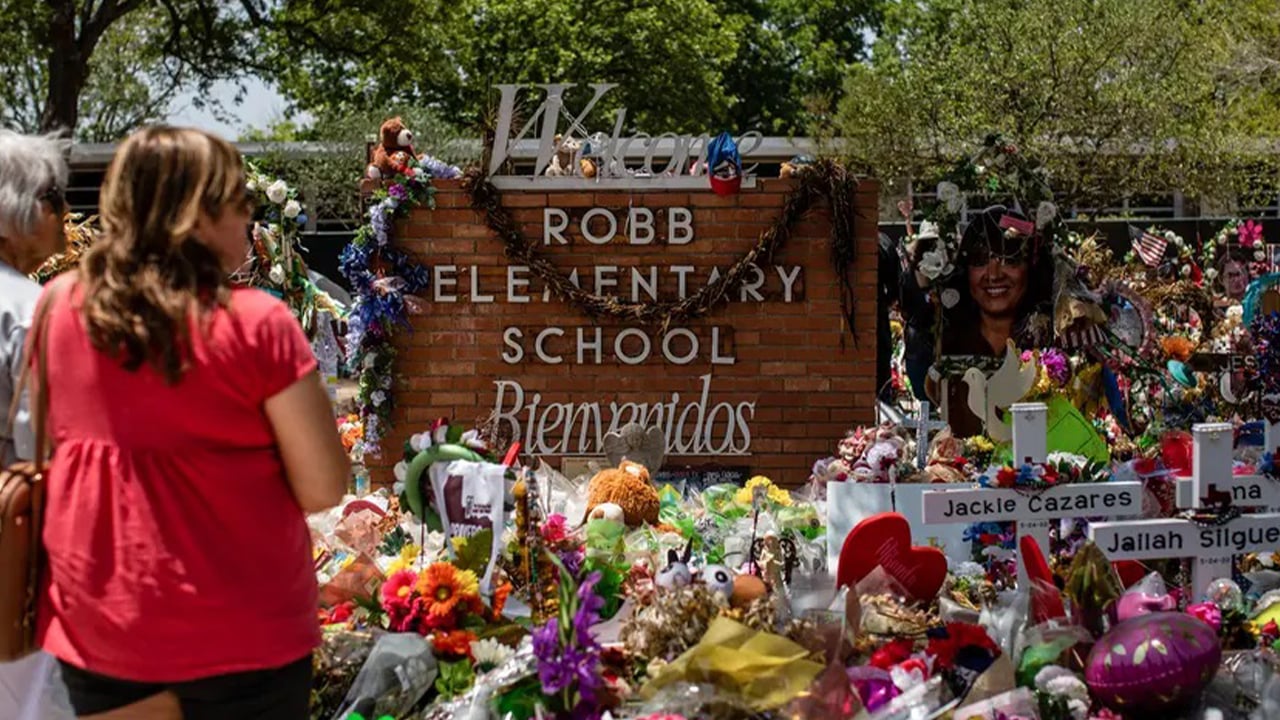
Mourners visit a memorial at Robb Elementary School in Uvalde, where a gunman killed 19 students and two teachers.
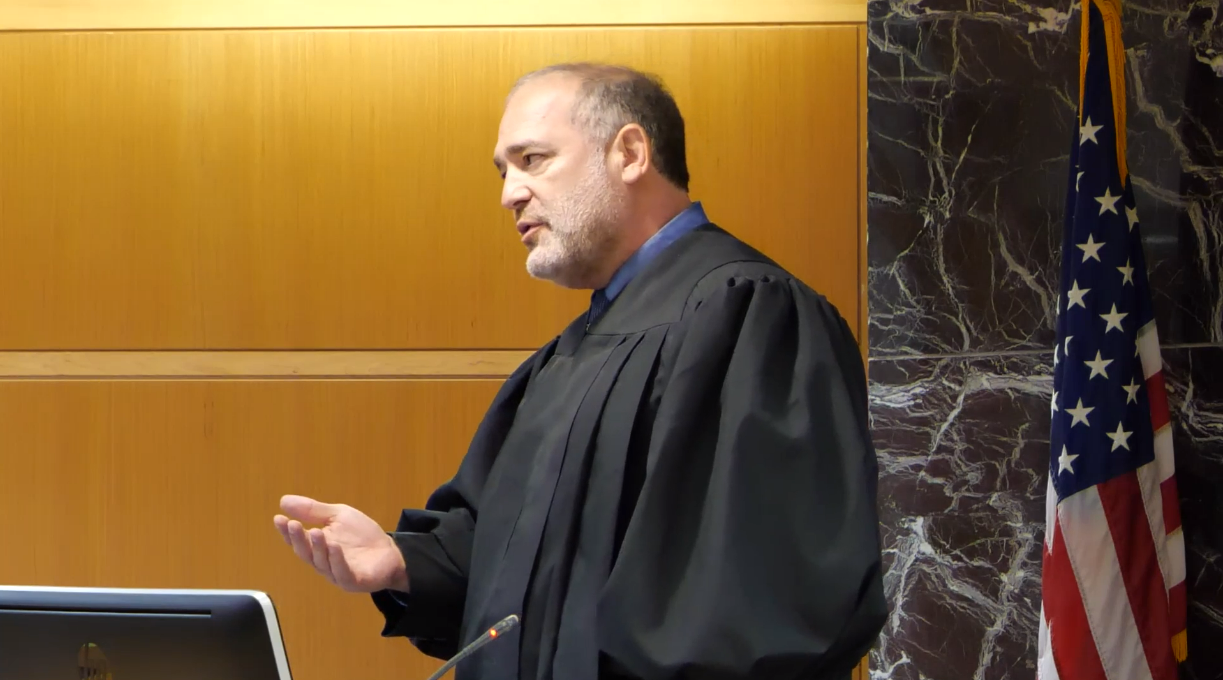
Red flag law in action: Pinellas-Pasco Circuit Judge Pat Siracusa held six risk protection order hearings on June 16, 2022, in Florida, where he decided whether or not to grant an order temporarily restricting residents from possessing or purchasing firearms or ammunition for one year.
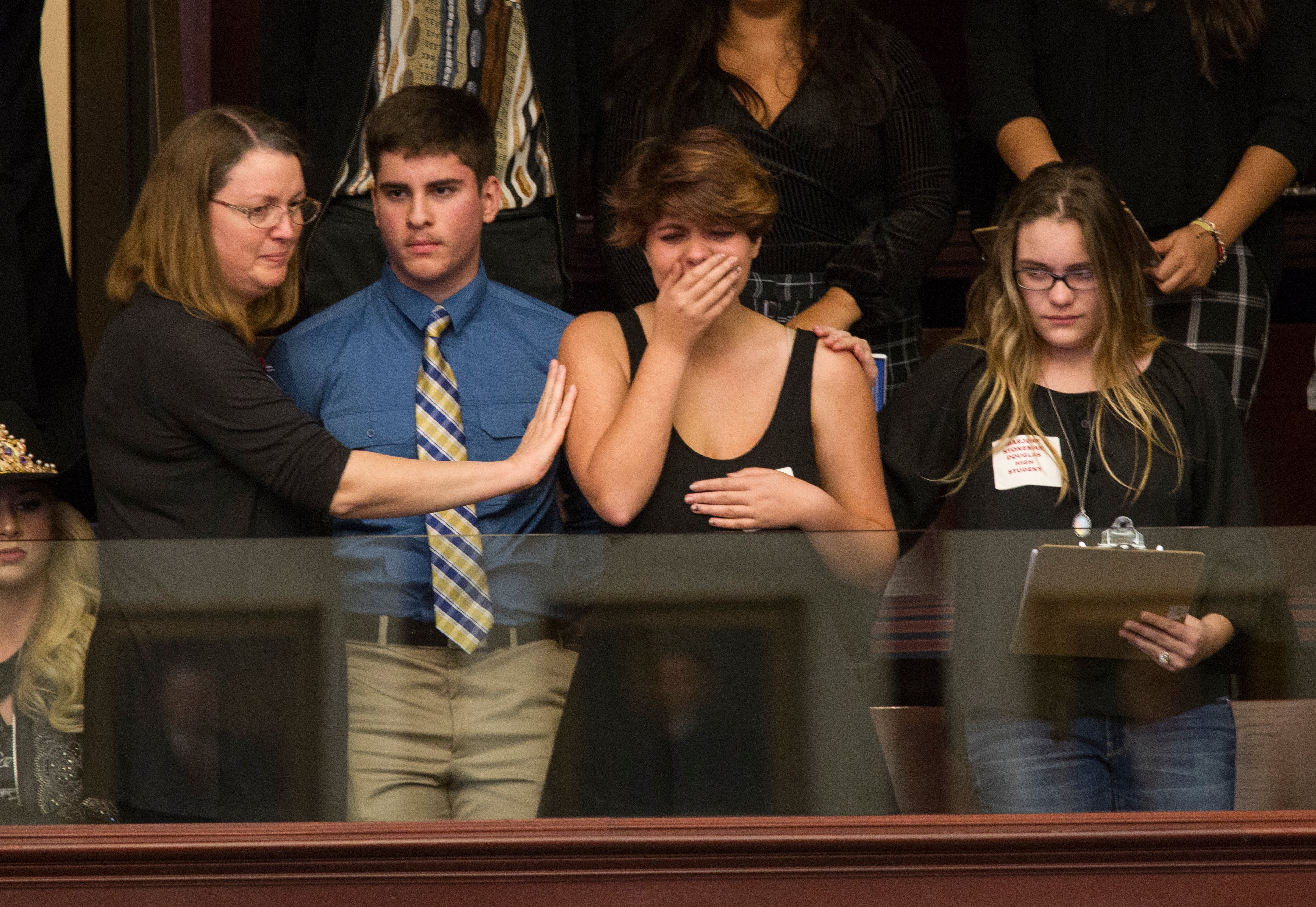
Students take action: Marjory Stoneman Douglas High School junior Sheryl Acquarola reacts after the representatives voted not to hear a bill that would ban assault rifles on Feb. 20, 2018. (AP photo)

Story continues below timeline


Back
to top

Back
to top